Semana 4


Resumen Semana 4


Equipo 19. Cálculo 3 - UNAM.


Versión PDF

Clase 16: 17/08/2020

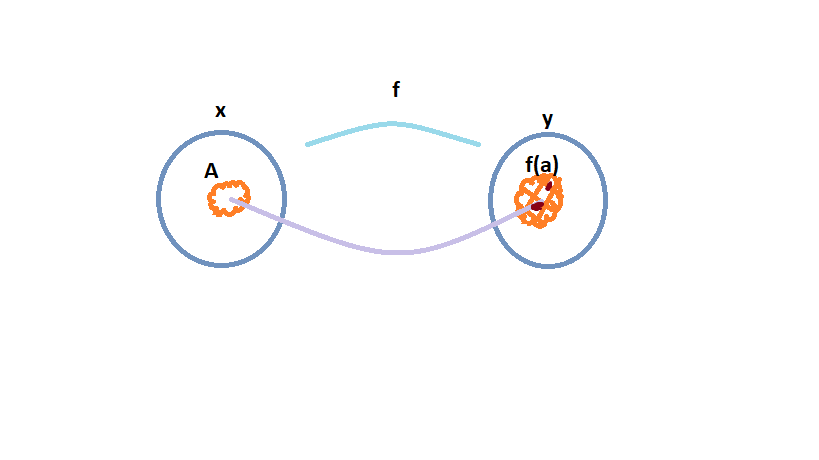
Definición II.1   Sea $f:X\rightarrow Y$ una función y $A\subset X$, Definimos y denotamos la imagen de A por:

$f(A)=\{ y \in Y :y=f(x)$ para alguna $x \in A\}$

Figura 1: Imagen directa
. []Image 1 []Image imd1

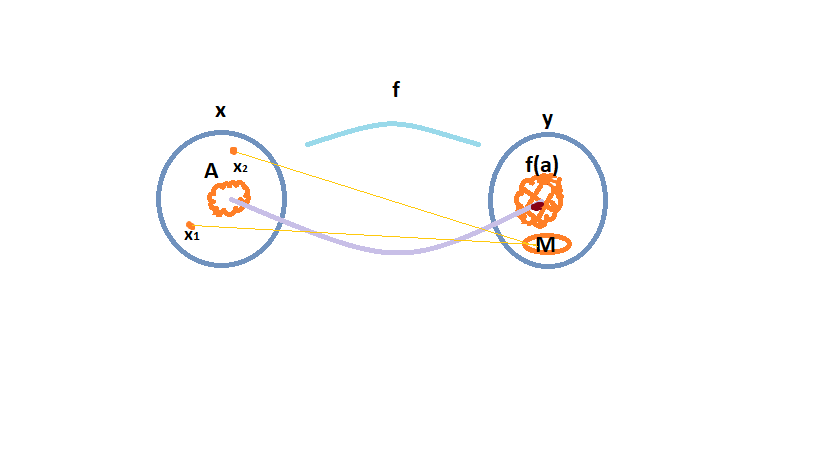
Definición II.2   Sea $f:X\rightarrow Y$ una función y $M \subset Y.$ Definimos y denotamos la imagen inversa de $M$ por:
$f^{-1}(M)= \{x \in X:f(x) \in M\}$

Figura 2: Imagen Inversa.
Image imagen inversa

Proposición II.1   Sean $f:X\rightarrow Y$ una función y $A,B \subset X.$ Entonces.

1.- $A \subset B \rightarrow f(A) \subset f(B) $
Dem: $y \in f(A) \Rightarrow y= f(x)$ p.a. $x \in A$, además $A \subset B \Rightarrow x \in B \Rightarrow f(x) \in f(B)$

2.- $f(A \cup B)=f(A) \cup f(B) $
$\Rightarrow$ $f(A \cup B) \in f(A) \cup f(B)$
Sea $y \in f(A \cup B) \Rightarrow \exists x \in A \cup B$ t.q. $y=f(x)$
Si $x \in A \Rightarrow y=f(x) \in f(A) \Rightarrow y \in f(A) \cup f(B).$

$\Leftarrow$ Si $x \in B$.Análogamente al caso anterior $A \subset (A \cup B) \Rightarrow f(A) \subset f(A \cup B)$ Por prop. 1 y $f(B) \subset f(A \cup B) \Rightarrow f(A) \cup f(B) \subset$

3.- $f(A \cap B) \subset f(A) \cap f(B)$
$A \cap B \subset A$ y $A \cap B \subset B$ Por prop. 1
$f(A \cap B) \subset f(A) y f(A \cap B) \subset f(B) $
$\Rightarrow$ $f(A \cap B) \subset f(A) \cap f(B)$

Proposición II.2   Sean $f:X\rightarrow Y$ donde $M \subset Y, f^{-1}(M)= \{x \in X:f(x) \in M\}$

1.- $F \subset G \Rightarrow f^{-1}(F) \subset f^{-1}(G)$
Dem: $x \in f^{-1}(F) \Rightarrow f(x) \in F \subset G \Rightarrow f(x) \in G \Rightarrow x \in f^{-1}(G).$

2.- $f^{-1}(F \cup G)= f^{-1}(F) \cup f^{-1}(G)$
Dem: $\Rightarrow$ $x \in f^{-1}(F \cup G) \Rightarrow f(x) \in F \cup G \Rightarrow f(x) \in F \Rightarrow x \in f^{-1}(F) \Rightarrow x \in f^{-1}(F) \cup f^{-1}(G) $

$\Leftarrow$ $f^{-1}(F) \cup f^{-1}(G) \subset f^{-1}(F \cup G)$
$F \subset F \cup G \Rightarrow f^{-1}(F) \subset f^{-1}(F \cup G)$ Por Prop.1 $\Rightarrow G \subset F \cup G \Rightarrow f^{-1}(G) \subset f^{-1}(F \cup G) \Rightarrow f^{-1}(F) \cup f^{-1}(G) \subset f^{-1}(F \cup G)$.

4.- $f^{-1}(F \setminus G)= f^{-1}(F)-f^{-1}(G)$
$\Rightarrow$ $x \in f^{-1}(F \setminus G) \Rightarrow f(x) \in (F \setminus G) \Rightarrow f(x) \subset F$ y $f(x) \not\in G \Rightarrow x \in f^{-1}(F)$ y $x \not\in f^{-1}(G) \Rightarrow x \in f^{-1}(F) \setminus f^{-1}(G)$

$\Leftarrow$ $x \in f^{-1}(F) \setminus f^{-1} (G) \Rightarrow x \in F^{-1} (F)$ y $x \not\in f^{-1} (G) \Rightarrow f(x) \in F$ y $f(x) \not\in (G) \Rightarrow f(x) \in F \setminus G \Rightarrow x \in f^{-1}$

Clase 17: 18/08/2020

Dudas.

Ejercicio 1   2.- Calcular la ecuación parametrica de la recta que pasa por P(0,0,0) y es ortogonal a las rectas $L_{1}$ y $L_{2}$ cuyas ecuaciones parametricas están dadas por:

$\left \{
\begin{array}{rcl}
\ x=1+\lambda\\
y=-2+4\lambda \\
z=1+7\lambda
\end{array} \right . $

$\left \{
\begin{array}{rcl}
\ x=4+\mu\\
y=1+2\mu \\
z=-1+5\mu
\end{array} \right .$

$\Rightarrow$ $L_{1}:(x,y,z)= \lambda \overline{u}+p_{1}$
$L_{2}:(x,y,z)= r\overline{v}+p_{2}$ $\Rightarrow$ $L:(x,y,z)= t\overline{w}$ $\Rightarrow$ $\overline{w}=\overline{u}\times \overline{v}$

$\left \{
\begin{array}{rcl}
\ x=1+\lambda\\
y=-2+4\lambda \\
z=1+7\lambda
\end{array} \right . $

$\left \{
\begin{array}{rcl}
\ x=4+\mu\\
y=1+2+4\mu \\
z=-1+5\mu
\end{array} \right . $

$(1,4,7)=\overline{u}$, $p_{1}=(a,b,c)$ $\Rightarrow$ $(x,y,z)=\lambda(u_{1}, u_{2}, u_{3})+p $

$\left \{
\begin{array}{rcl}
\ x=\lambda u_{1}+a\\
y=\lambda u_{2}+b \\
z=\lambda u_{3}+c
\end{array} \right . $

$L_{2} (1,2,5)=\overline{v}$ $\Rightarrow$ $\overline{w}=\overline{u}\times\overline{v}=(6,2,-2)$ $\Rightarrow$ $L:(x,y,z)=t(6,2,-2),t \in \mathbb{R}$ $\Rightarrow$ $\left\{
\begin{array}{rcl}
\ x=6t\\
y=2t\\
z=-2t
\end{array} \right . $

Ejercicio 2   15.- Demuestre que el limite indicado no existe.

$\displaystyle \lim_{(x,y) \to (0,0)} \frac{\sqrt[3]{x}y^{2}}{x+y^{3}}
$

Si evaluamos se indetermina entonces si $x=y$ $\Rightarrow$ $\frac{\sqrt[3]{x}x^{2}}{x+x^{3}}= \frac{x^{2/3}}{x+x^{3}}$
Si $x=y^{3}$ $\Rightarrow$ $\frac{\sqrt[3]{y^{3}}y^{2}}{y^{3}+y^{3}}= \frac{y^{3}}{2y^{3}}=\frac{1}{2}$ Si $x=t^{6}$ y $y=-t$ $\Rightarrow$ $\frac{\sqrt[3]{t^{6}}t^{2}}{{t^{6}}-t^{3}}= \frac{t^{4}}{t^{6}-t^{3}}= \frac{t^{3}}{t^{3}}= \frac{t}{t^{3}-1}$ $\Rightarrow$ $t\rightarrow 0$ $\Rightarrow 0$

Superficie de nivel

$f(x,y,z)= z^{2}+(\sqrt{x^{2}+y^{2}}-2)^{2}-1$ La gráfica vive en $\mathbb{R}^{4}$, no la podemos dibujar.
Superficie de nivel C. $(x,y,z)/ z^{2}+(\sqrt{x^{2}+y^{2}-2)^{2}-1}=C$

$C=-1$ $C=0$ $C=1$ $\Rightarrow$ Si $x=0$ $(YZ)$ $\Rightarrow$ $\sqrt{y^{2}}= \abs {y}$
$z^{2}+(\abs {y}-2)^{2}-1=C$
$z^{2}+(\abs {y}-2)^{2}=C+1>0$
Si $y=0$ $(XZ)$ $\Rightarrow$ $z^{2}+(x-2)^{2}=C+1$
Si $z=0$ $\Rightarrow$ $\sqrt{x^{2}+y^{2}-2)^{2}}=C+1$
$x^{2}+y^{2}-4\sqrt{x^{2}+y^{2}+4}=C+1$

Clase 18: 19/08/2020

(a) ( $\cup_{\alpha \in I}A_{\alpha}) \cap B= \cup_{\alpha \in I}(A_{\alpha}\cap B)$

$\Rightarrow$ $x \in (\cup_{\alpha \in I}A_{\alpha}) \cap B$
P.D. $x \in \cup_{\alpha \in I}(A_{\alpha}\cap B)$
$x \in \cup_{\alpha \in I} A_{\alpha}$ y $x \in B$ $\Rightarrow$ $x \in A_{\alpha 0}$ para algún, $\alpha_{0} \in I$ $\Rightarrow$ $x \in A_{\alpha 0} \cup B$ $\Rightarrow$ $\cap_{\alpha \in I}(\cup_{\alpha \in I} (A_{\alpha} \cap B).$
$\Leftarrow$ $x \in \cup_{\alpha \in I} (A_{\alpha}\cap B) \Rightarrow \exists \alpha_{0} \in I$ t.q. $x\in A_{\alpha 0}\cap B$ $\Rightarrow$ $x \in A_{\alpha 0}$ y $x \in B$ $\Rightarrow$ $x\in \cup_{\alpha \in I}$ y $x \in (\cup_{\alpha \in I}A_{\alpha}) \cap B$

$F= \{A_{\alpha}: \alpha \in I\}$

(a) ( $\cup_{\alpha \in I}A_{\alpha})^{c}= \cap_{\alpha \in I} A_{\alpha}^{c}$

(b) ( $\cap_{\alpha \in I}A_{\alpha})^{c}= \cup_{\alpha \in I} A_{\alpha}^{c}$

Demostración.
$\Rightarrow$ $x \in (\cap_{\alpha \in I} A_{\alpha})^{c}$ $\Rightarrow$ $x \notin A_{\alpha} \forall \alpha \in I$ $\Rightarrow$ Para cada $\alpha \in I, x \in A_{\alpha}^{c}$ $\Rightarrow$ $x \in \cup_{\alpha \in I} A_{\alpha}^{c}$
$\Leftarrow$ $x \in \cap_{\alpha \in I} A_{\alpha}^{c}$ $\Rightarrow$ $x \in A_{\alpha}^{c} \forall \alpha \in I$ $\Rightarrow$ $\notin A_{\alpha} \forall \alpha \in I$ $\Rightarrow$ $x \notin \cup_{\alpha \in I} A_{\alpha}$ $\Rightarrow$ $x \in (\cap_{\alpha \in I} A_{\alpha})^{c}$

5.- Demuestre que $\cap_{k=1}^{\infty} B_{\frac{1}{K}}(0)=\{0\}$

\includegraphics[width=0.4\textwidth]{5.PNG}

$\cap_{k \in \mathbb{N} } (-\frac{1}{k},\frac{1}{k})= \{0\}$ si $\cap(\frac{1}{k},\frac{1}{k}) \not= \{0\}$ $\Rightarrow$ $\exists \epsilon >0$ t.q. $0<\epsilon< \frac{1}{k} \forall k \in \mathbb{N}$
$k< \frac{1}{\epsilon} \forall k \in \mathbb{N}!$
$\mathbb{N}$ no están acotados superiormente.

9.- Sea A= $\{ \frac{n}{n+1}: n \in \mathbb{N} \}$ Demuestra que A tiene solo un punto de acumulación. ¿Quien es la adherencia de A? y $F_{r}(A)$ y $A^{\circ}$

\includegraphics[width=0.4\textwidth]{9.PNG}

$B_{r}(\frac{2}{3})\vert\frac{2}{3}) \cap A = \emptyset$

Af. $\forall$ $(B_{\epsilon}(1)\vert \{1\}) \cap A \not= \emptyset$
Sup. por el contrario que $\exists \epsilon >0$ t.q. $(B_{\epsilon}(1)\vert \{1\}) \cap A \not= \emptyset$ $\Rightarrow$ $\frac{n}{n+1} \leq 1-\epsilon \forall n \in \mathbb{N}$
$\Rightarrow$ $n \leq (n+1)(1-\epsilon) \forall n \in \mathbb{N}$
$\Rightarrow$ $n \leq n-n \epsilon+1-\epsilon \forall n \in \mathbb{N}$ $\Rightarrow$ $n \leq \frac{1-\epsilon}{\epsilon} \forall n \in \mathbb{N} !$

Composición de funciones continuas.

Sean $f:U \subset \mathbb{R}^{n} \rightarrow \mathbb{R}^{m}$ y $g:V \subset \mathbb{R}^{m} \rightarrow \mathbb{R}^{p}$ donde $U$ es abierto en $\mathbb{R}^{n}$ y $V$ es abierto en $\mathbb{R}^{m}$
Si $f$ es continua en $x_{0}\in U$ entonces la función compuesta $g \circ f: U \subset \mathbb{R}^{p}$ es continua en $x_{0}$
Demostración.
Dado $\epsilon > 0$, por ser $g$ continua en $f(x_{0})$, existen $n>0$ tal que. $\norm {y-f(x_{0})} <n$ $\Rightarrow$ $\norm {g(y)-g(f(x)} < \epsilon$
Como $f$ es continua en $x_{0}$, existe $\delta > 0$ tal que
$\norm {x-x_{0}} < \delta$ $\Rightarrow$ $\norm {f(x)-f()x_{0}} < n$
De ambas aplicaciones concluimos que dado $\epsilon > 0$, existe $\delta > 0$ tal que
$\norm {x-x_{0}} < \delta$ $\Rightarrow$ $\norm {g(f(x_{0}))} < \epsilon$
Por lo tanto $g \circ f$ es continua en $x_{0}$

Clase 19: 20/08/2020

Dudas.
$f$ es una parametrizacion de una curva. $(\cos t, \sin t, 1-\sin t)$ $\Rightarrow$ $\left \{
\begin{array}{rcl}
\ x=\cos t\\
y=\sin t \\
z=1-\sin t
\end{array} \right . $ Ecuación parametrica.
Sabemos $\cos ^{2}t+\sin^{2}t=1$ $\Rightarrow$ $x^{2}+y^{2}=1$ $\Rightarrow$ $z=1-y$ $\Rightarrow$ $0x+y+z-1=0$ $\Rightarrow$ $(0,1,1)= \overline{n}$

Ecuación de la Recta.
$(x,y,z)=t \overline{u}+ \overline{v}, t\in \mathbb{R}$
Param. $\gamma: \mathbb{R}\rightarrow\mathbb{R}^{3}$ $\Rightarrow$ $\gamma(t)=t\overline{u}+\overline{v}$ $\Rightarrow$ $t\rightarrow t\overline{u}+\overline{v}$

\includegraphics[width=0.4\textwidth]{cap1.PNG}

$f: \mathbb{R}^{3} \rightarrow \mathbb{R}$ Función escalar
$f(x,y,z)= z^{2}+(\sqrt{x^{2}+y^{2}}-2)^{2}-1$
Encontrar la superficie de nivel para $C_{1}=-1$, $C_{2}=0$, $C_{3}=1$ $\Rightarrow$ $z^{2}+(\sqrt{x^{2}+y^{2}}-2)^{2}-1=-1$
$\Rightarrow$ $z^{2}+(\sqrt{x^{2}+y^{2}}-2)^{2}=0$ Superficie en $\mathbb{R}^{3}$ trazar $x=0$ plano (YZ) $\Rightarrow$ $z^{2}+(\abs {y}-2)^{2}=1$ $\Rightarrow$ $\sqrt{y^{2}}= \abs {y}$ $\Rightarrow$ $y=2$ o $y=-2$ $\Rightarrow$ Sol. $\{0,2,0\} , \{0,-2,0\}$ Con $y=0$ plano $(ZX)$ $z^{2}+(\abs {x}-2)^{2}=1$ circulo de radio 0 $\Rightarrow$ Sol {(2,0,0), (-2,0,0)}
$z=0$ Plano (XY) $\Rightarrow$ $(\sqrt{x^{2}+y^{2}}-2)^{2}=0$ $\Rightarrow$ $\sqrt{x^{2}+y^{2}}-2=0$ $\Rightarrow$ $x^{2}+y^{2}=4$ $\Rightarrow$ $(\sqrt{x^{2}+y^{2}}-2)=1$ $\Rightarrow$ $x^{2}+y^{2}=9$ $\Rightarrow$ Circulo con radio $3$
$z^{2}+(\sqrt{x^{2}+y^{2}}-2)^{2}-1$ $\Rightarrow$ $z^{2}=-(\sqrt{x^{2}+y^{2}}-2)^{2}+1$ $\Rightarrow$ $z=\pm \sqrt{1-(\sqrt{x^{2}+y^{2}}-2)^{2}}$ Si $(x,y)$ cumple $1-(\sqrt{x^{2}+y^{2}}-2)^{2} \geq 0$ $\Rightarrow$ $1\geq(\sqrt{x^{2}+y^{2}}-2)^{2}$ Frontera $\Rightarrow$ $1=\sqrt{x^{2}+y^{2}}-2$ $\Rightarrow$ $3^{2}= x^{2}+y^{2}$ Es un circulo de radio $3$

\includegraphics[width=0.4\textwidth]{Captura6.PNG}

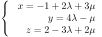
$\left \{
\begin{array}{rcl}
\ x=-1+2\lambda+3\mu\\
y=4\lambda-\mu \\
z=2-3\lambda+2\mu
\end{array} \right . $ $\Rightarrow$ $2x-5y+z=0 :\pi_{2}$

$\pi :(x,y,z)= t\overline{u}+s\overline{v}+P$
$\overline{u}\times\overline{v}=\overline{n}= \Pi \cap \Pi$
$<(x,y,z)-P,\overline{n}>=0$ Ecuación del plano
$\Rightarrow$ $\Pi_{1}=\lambda \overline{\alpha}+\mu\overline{\beta}+\overline{\gamma}=(x,y,z)$ $\Rightarrow$ $\lambda(2,4,-3)+\mu(3,\frac{-1}{\beta},2)+(-1,0,2)$ $\Rightarrow$ $\overline{\alpha}\times \overline{\beta}=\overline{n_{1}}$
$\Rightarrow$ $\Pi_{1}: <\overline{x}-\overline{\Gamma},\overline{n_{1}}=0$ Ecuación cartesiana.


 Clase 20 de Agosto de 2020


Comentarios

Entradas populares de este blog

Integrantes

Demostración Teorema 2 y que R^{3} es EV

Actividad 3 de 10